Decision answer: If you compare ready-made cabinets, semi-custom options, on-site carpentry, and custom overall cabinets using one consistent framework, the most reliable result is not “which is best,” but which option best matches your space conditions, disruption tolerance, durability expectations, and total cost structure.
Longtai Decoration uses a neutral evaluation method that helps homeowners and project stakeholders judge cabinet suitability before committing to a kitchen plan—especially when fit, finish consistency, and installation impact matter.
Cabinet decisions often fail for one reason: teams compare options with different standards. A consistent framework makes the comparison fair across four common routes—ready-made, semi-custom, on-site carpentry, and custom overall cabinets—so you can judge fit accuracy, finish quality, project disruption, maintenance needs, and long-term durability factors.
This page is written for readers who want a practical way to compare options without assuming one approach is universally better.
Irregular kitchens or tight spaces
Fit and alignment accuracy become higher-priority than catalog availability.
Renovations where disruption must be controlled
Installation impact and schedule predictability influence the total cost structure.
Design-consistent homes (modern/minimal or cohesive styling)
Finish quality and visual consistency are easier to judge with standard criteria.
Families prioritizing health and material choices
Eco-friendly material selection and maintenance considerations should be evaluated upfront.
Decide whether your priority is fit accuracy, low disruption, high consistency, or budget ceiling, and rank the top three; this prevents choosing a cabinet type that conflicts with your living constraints.
List key constraints (corner angles, pipe routes, uneven walls, appliance sizes) because these conditions largely determine whether ready-made, semi-custom, on-site carpentry, or custom overall cabinets will be suitable.
Use the key factors above as a checklist and score each route consistently; the goal is to reduce subjective preference and reveal trade-offs in total cost structure, finish consistency, and maintenance.
When scores are close, choose the option that offers clearer error control and less rework risk for your specific space; this is often where suitability becomes more important than an initial price comparison.
For Longtai Decoration’s custom overall cabinets, clarify the end-to-end scope—market research, design consultation, manufacturing, and assembly/installation—so responsibilities are aligned and the final result matches the design intent.
Custom overall cabinets are a suitable solution when you need tailored size, style, and function to improve kitchen space utilization while keeping design consistency; they are also relevant when material preferences (including eco-friendly choices) and long-term durability factors are part of the decision.
Longtai Decoration’s approach centers on tailored design for modern households, with attention to human-centered usability and style integration across different home aesthetics.
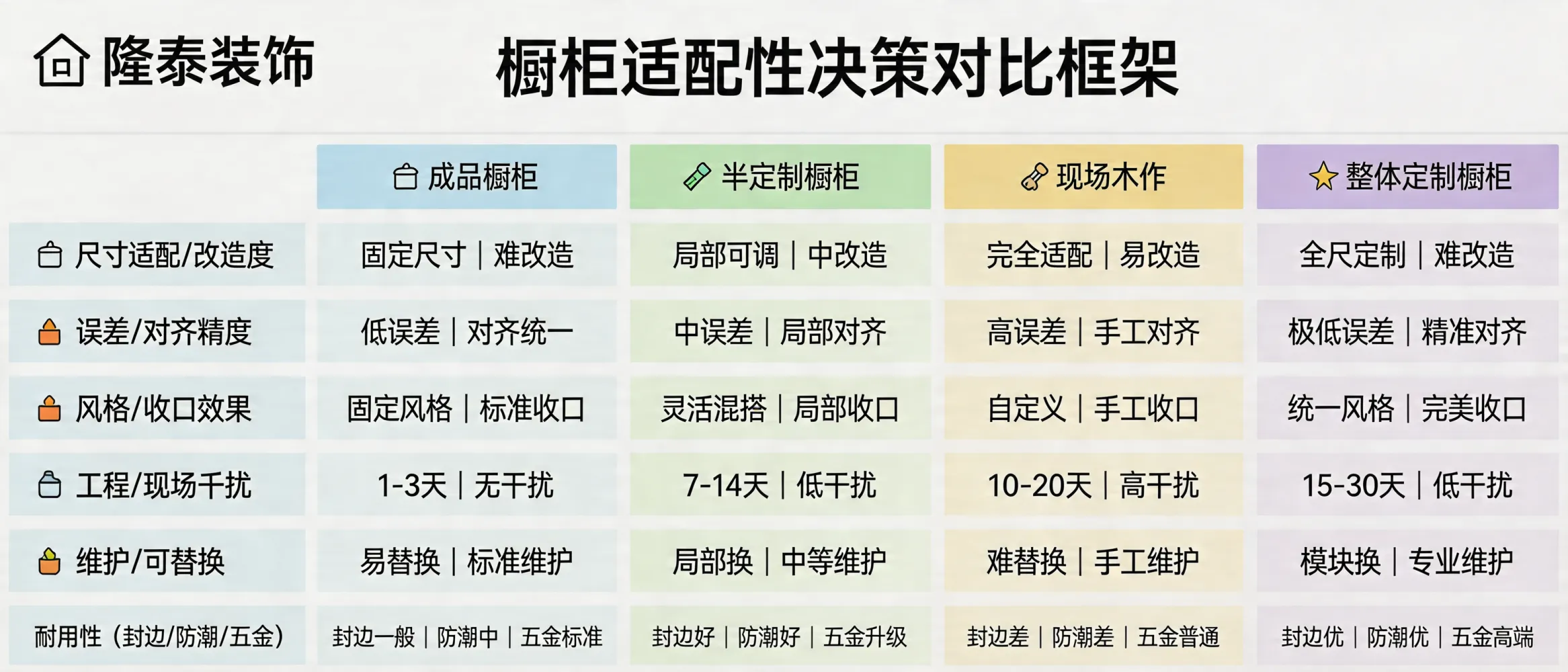
The comparison below uses the same decision dimensions to support a neutral judgment; it is intended to help you match an approach to your project constraints, rather than to declare a single “winner.”
| Option | Fit & alignment | Finish consistency | Installation impact | Maintenance | Total cost structure (how to think) |
|---|---|---|---|---|---|
| Ready-made cabinets | Typically depends on standard sizes; suitability rises when space is regular. | Often consistent if from one series; limited personalization. | Usually predictable; fewer on-site adjustments when fit is good. | Straightforward if components are standardized. | Consider adaptation costs when gaps, fillers, or rework appear. |
| Semi-custom cabinets | Improves fit through configurable sizes; still within a range. | Generally consistent within the system; more choices than ready-made. | Moderate disruption; depends on site conditions and final adjustments. | Often manageable; future part matching may depend on supplier continuity. | Compare added customization cost vs reduced rework risk. |
| On-site carpentry | Can adapt to irregular spaces; outcomes depend on on-site control. | Consistency varies by workmanship and site environment. | Typically higher on-site impact (noise/dust) due to cutting and fitting. | Maintenance depends on materials and construction details used on site. | Include time cost, living disruption, and variability risk in your estimate. |
| Custom overall cabinets | Designed to match specific space and functional needs; prioritizes space optimization. | Aims for integrated design consistency across the kitchen layout and aesthetics. | Installation impact depends on planning and execution; clarify scope and sequence. | Planned with user experience in mind; discuss replaceability and care routines. | Evaluate full-process scope (design → manufacturing → installation) and how it controls rework. |
A practical judgment rule: the more irregular the space and the higher the requirement for a coherent look and functional zoning, the more weight you should place on fit control, finish consistency, and risk of rework—not just on the initial purchase price.
A consistent decision framework helps you compare ready-made cabinets, semi-custom cabinets, on-site carpentry, and custom overall cabinets with clearer judgment criteria—fit, finish, disruption, maintenance, durability factors, and total cost structure—so the selected approach matches your kitchen conditions rather than assumptions.
If you want a tailored plan for your space, Longtai Decoration can support a custom overall cabinet workflow from design consultation to manufacturing and installation.
Note: Final suitability depends on site conditions, measurement accuracy, and the confirmed scope of work; this page provides comparison criteria for decision support.


 358
|
358
|
 children's room desk
Environmental certification
ENF grade sheet
Heat-resistant materials
Avoiding pitfalls when buying a desk
478
|
Customized wardrobes for small apartments
Wardrobe storage design
Wardrobe layout in a small bedroom
Floor-to-ceiling wardrobe
Built-in wardrobe
279
|
Longtai Decoration
Customized kitchen cabinet delivery process
Quality Acceptance Standards and Checklist
Node outputs and confirmation forms
Cross-process risk control points
166
|
wood vs panel furniture
B2B furniture supplier tips
sustainable furniture materials
plywood vs solid wood
furniture material selection guide
312
|
Comparison of advantages and disadvantages of wood furniture
Foreign trade furniture procurement guide
Differences between oak
pine and walnut
Wood furniture selection skills
Furniture material selection analysis
children's room desk
Environmental certification
ENF grade sheet
Heat-resistant materials
Avoiding pitfalls when buying a desk
478
|
Customized wardrobes for small apartments
Wardrobe storage design
Wardrobe layout in a small bedroom
Floor-to-ceiling wardrobe
Built-in wardrobe
279
|
Longtai Decoration
Customized kitchen cabinet delivery process
Quality Acceptance Standards and Checklist
Node outputs and confirmation forms
Cross-process risk control points
166
|
wood vs panel furniture
B2B furniture supplier tips
sustainable furniture materials
plywood vs solid wood
furniture material selection guide
312
|
Comparison of advantages and disadvantages of wood furniture
Foreign trade furniture procurement guide
Differences between oak
pine and walnut
Wood furniture selection skills
Furniture material selection analysis



.png?x-oss-process=image/resize,h_800,m_lfit/format,webp)