Modular Desk and Chair Sets for Open-Plan Workstations and Flexible Collaboration Zones
Longtai Jewelry
2026-04-11
Solution
This article examines how modern minimalist modular desk and chair sets are being applied to solve common workspace challenges in open-plan workstations and flexible collaboration zones. By mapping typical pain points—such as uneven space utilization, frequent layout changes, noise and privacy trade-offs, and inconsistent team support—into scenario-based configurations, it explains how modular combinations improve spatial coherence and functional efficiency. The discussion integrates practical case snapshots and user feedback metrics to illustrate measurable outcomes in utilization, comfort, and collaboration flow, supported by a brief designer interview pull-quote and a before/after comparison diagram concept for clearer decision-making. Written for HR leaders, workplace planners, and corporate procurement teams, it provides actionable selection and configuration guidance to support smarter office upgrades and a more human-centered employee experience—aligned with Longtai Decoration’s workplace optimization approach.
From Open-Plan Workstations to Agile Collaboration Zones: A Scenario-Based Guide to Modular Desk & Chair Sets
Many offices have learned the same lesson the hard way: adding more seats is easy; maintaining focus, flow, and team alignment is not. In open-plan layouts, noise, ad-hoc meetings, and messy cable management can quietly tax productivity. In collaboration areas, furniture that “looks flexible” often fails under real use—too heavy to move, too few power points, and no clear zoning. This tutorial explains how modular desk and chair sets—designed in a modern minimalist style—can be configured to solve these issues with measurable gains in space utilization, employee experience, and procurement efficiency.
1) The Real Pain Points: What Open Offices and Collaboration Zones Get Wrong
Open-plan workstations: density without clarity
Open-plan seating can improve communication, but often introduces friction that compounds daily. Acoustic distractions, unclear circulation paths, and “temporary” personal storage turning permanent are common. In workplace studies frequently cited by corporate real estate teams, noise interruptions alone can reduce task performance by around 5–10% for focus-heavy roles, especially in departments like finance, engineering, and customer support.
Seat-to-aisle conflict: chairs blocking walkways, causing micro-delays and safety concerns.
Power and cable chaos: extension cords and “floating” adapters reduce perceived professionalism.
One-size seating: mismatch between posture needs and standardized chair specs.
Flexible collaboration zones: movement without structure
Collaboration areas work best when they support both planned workshops and spontaneous huddles. Yet many teams experience “furniture friction”: tables are difficult to reconfigure, chairs are uncomfortable for 45–60 minute sessions, and there’s limited separation between discussion and quiet work. A common internal benchmark used by HR and facilities teams is reconfiguration time; when it exceeds 10 minutes, teams stop adapting the space and simply tolerate suboptimal setups.
Reconfiguration overhead: too heavy, too few modular options, no docking logic.
Inconsistent ergonomics: chairs that fit “quick talks” but not real work sessions.
Weak zoning: collaboration noise spills into focus areas.
2) Why Modular Works: The Modern Minimalist Design Logic (Beyond Aesthetics)
“Modern minimalist” is often treated as a visual style. In office planning, it is more accurately a system: fewer incompatible parts, clearer assembly logic, and predictable maintenance. Modular combinations—tables, chairs, and linking components—allow procurement and facilities teams to build consistent standards while still giving departments the freedom to shape their space.
Modularity that procurement can actually manage
The best modular desk and chair sets don’t just “combine”—they standardize. Standard footprints, repeatable connector points, and uniform finishes reduce SKU sprawl and simplify replenishment. Many organizations report that standardization can reduce spare-part complexity by 20–30% over a 12–18 month cycle, especially when chair parts and tabletop components are shared across zones.
Space utilization: measurable, not theoretical
In open offices, modular planning supports a cleaner “grid” with fewer dead corners. In collaboration zones, modular units allow capacity scaling without redesign. In typical fit-outs, facilities teams often target a 10–15% improvement in usable space by reducing oversized meeting tables and adopting reconfigurable clusters that match real attendance patterns.
Human factors: chairs and micro-comfort
A modular system succeeds only when seating is not an afterthought. For mixed-use zones, organizations often choose chairs that balance stackability, stable back support, and easy-clean surfaces. Even small upgrades—proper lumbar geometry and breathable materials—tend to correlate with higher satisfaction in internal surveys. In many office refresh projects, an uplift of 8–12 points in “workspace comfort” scores is considered a strong result after furniture replacement.
3) Scenario Playbook: Two Configurations That Solve 80% of Daily Use
Scenario A — Open Workstations: “Order + Access” configuration
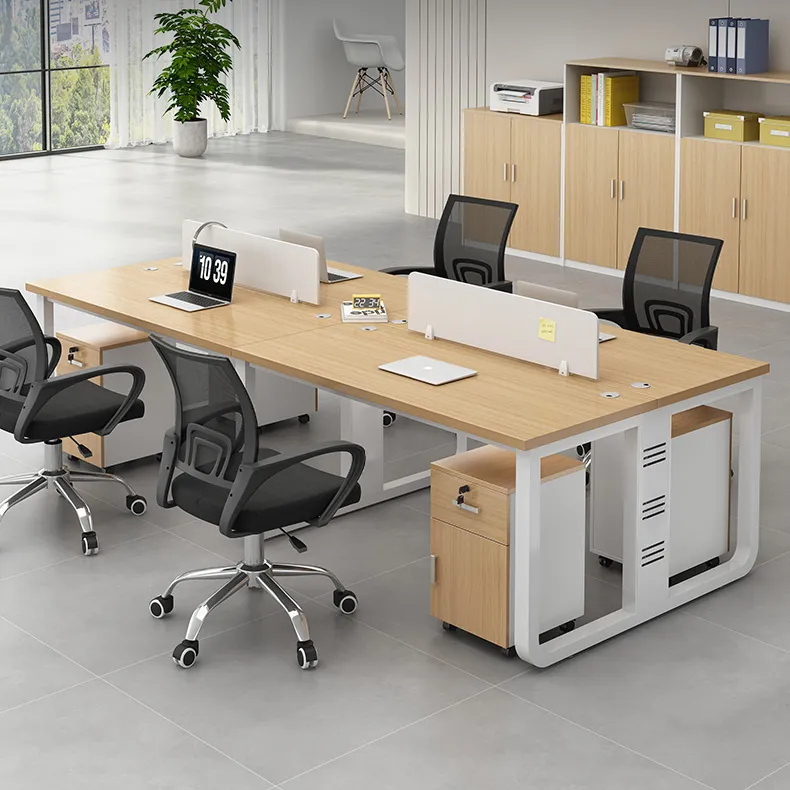
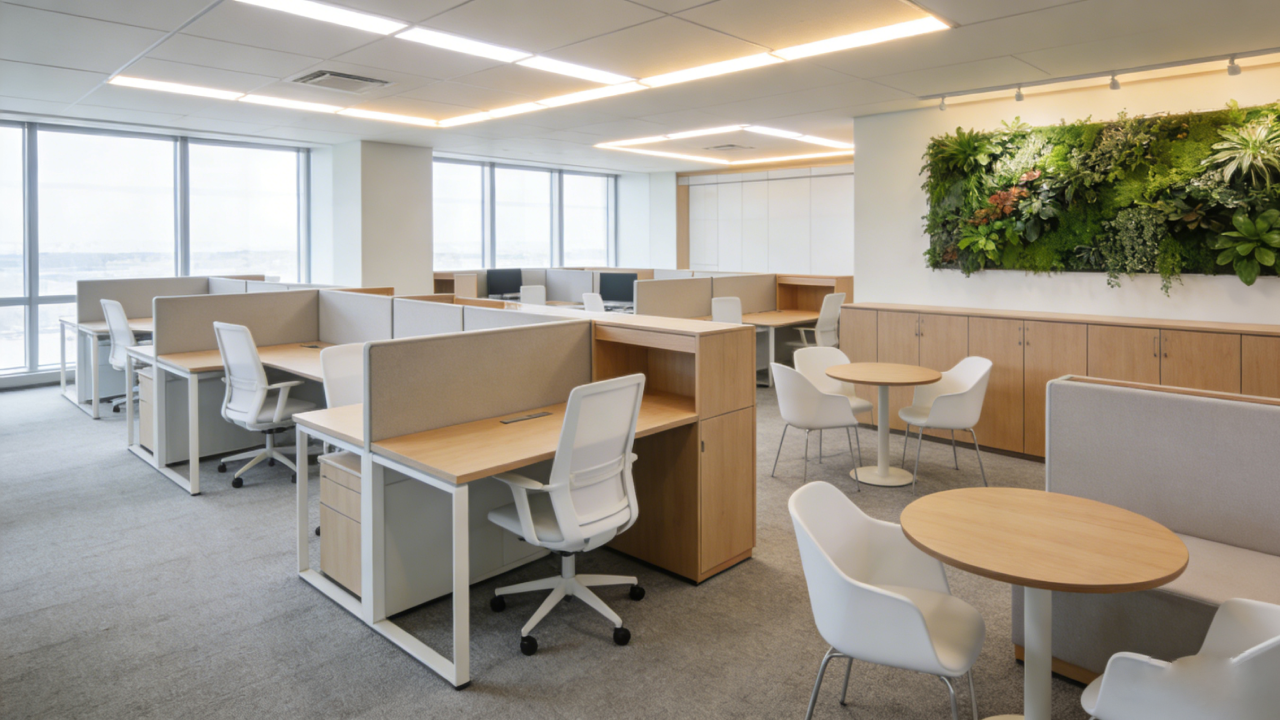
The objective is to reduce movement conflicts and keep power/cables invisible without adding bulky partitions. In practice, this configuration uses modular desk runs with predictable aisle widths and shared wiring lanes. Teams keep their daily workflow inside a clean, repeatable workstation pattern.
Planning rule: maintain clear circulation so chairs can slide out without blocking the main aisle.
IT-ready detail: central cable routing and standardized access points reduce “desk downtime” during moves.
Procurement benefit: repeatable modules simplify future expansion for new hires.
Scenario B — Collaboration Zones: “Cluster + Dock” configuration
The objective is to make collaboration easy while keeping it contained. Modular tables form clusters for 4–8 people and “dock” back into a tidy baseline layout. Chairs support both short stand-ups and longer sessions without feeling like meeting-room seating.
Time metric: target a reset time under 5 minutes to keep the space truly agile.
Zoning cue: consistent furniture language signals “collaboration mode” without heavy construction.
Operations detail: surfaces and edges optimized for frequent cleaning and high turnover.
4) Proof in Numbers: What Teams Typically Measure After a Modular Upgrade
In the awareness stage, decision-makers benefit from practical KPIs rather than lofty promises. Below is a realistic comparison framework frequently used by HR, workplace strategy, and procurement teams to evaluate office furniture solutions.
Before vs. After: Typical Outcomes of Modular Desk & Chair Sets (Reference Range)
Metric
Common Baseline
After Modular Upgrade (Typical)
Why It Matters
Space utilization (usable area)
Dead corners, oversized tables
+10–15% usable space
More seats or bigger aisles without expansion
Reconfiguration time (collab zone)
10–20 minutes
3–7 minutes
If it’s not fast, teams stop reconfiguring
Employee comfort score (internal survey)
Mixed satisfaction
+8–12 points
Comfort influences retention and daily focus
Move/add/change disruption (facilities + IT)
Frequent downtime
15–25% less disruption
Standard modules reduce surprises and rework
Notes: Ranges vary by department mix, density targets, and whether acoustic and lighting upgrades accompany the furniture refresh.
5) A Buyer’s Checklist for HR, Space Planners, and Procurement
For teams evaluating modern office furniture, the most reliable approach is to map furniture specs to daily behaviors. The checklist below is intentionally practical and easy to verify during sampling or mock-up.
Ergonomics & comfort
Chair comfort holds up for 45–60 minute work sessions (not only short chats).
Stable posture support and breathable materials for high-usage areas.
Easy-clean surfaces for shared seating (especially in collaboration zones).
Modular logic & scalability
Standard footprints and connector compatibility across different zones.
Ability to expand seat count without redesigning the entire floor.
Cable routing and power access designed into the layout, not improvised.
Reset time for collaboration clusters is measurable and consistently low.
Materials and finishes aligned with maintenance and cleaning routines.
When these criteria are met, modular desk and chair sets become a repeatable workplace standard, not a one-time purchase. That’s where procurement value compounds: fewer exceptions, fewer emergency purchases, and a cleaner experience for employees.
Turn Layout Changes into Performance Gains—Without Rebuilding Your Office
隆泰装饰 helps teams translate real office behaviors into modular configurations that scale—open-plan workstations that stay orderly, and collaboration zones that reset in minutes. If the goal is higher space efficiency, smoother operations, and a more human workday, the next step is a configuration review based on your floor plan and headcount.











.png?x-oss-process=image/resize,h_800,m_lfit/format,webp)